The Three-Way Attack
A call to protect our land against the intertwined forces of corporate extraction, unchecked AI infrastructure, and a government that has abandoned its stewardship. From Cancer Alley to the data center gold rush — this is the generational battle.
Right now there is a generational battle for the United States of America. The battle to protect our environment. Because if we don’t, it will be pillaged by capitalism. This is our first shared battle that needs to be escalated. If we don’t do this, our land will be destroyed. There will be no Americans. There will be a wasteland. There will be a rich profit-tier class that is not living here anymore, somewhere else. If we don’t protect the land, we will have nothing left. Being an American will literally be equivalent to dust.
I feel like I’m waking up from a really long AI psychosis. I was one of the first when I saw it flash on my screen — ChatGPT — and I just thought, this is indistinguishable from magic. Then I became a user. Then I learned about the implications of this technology.
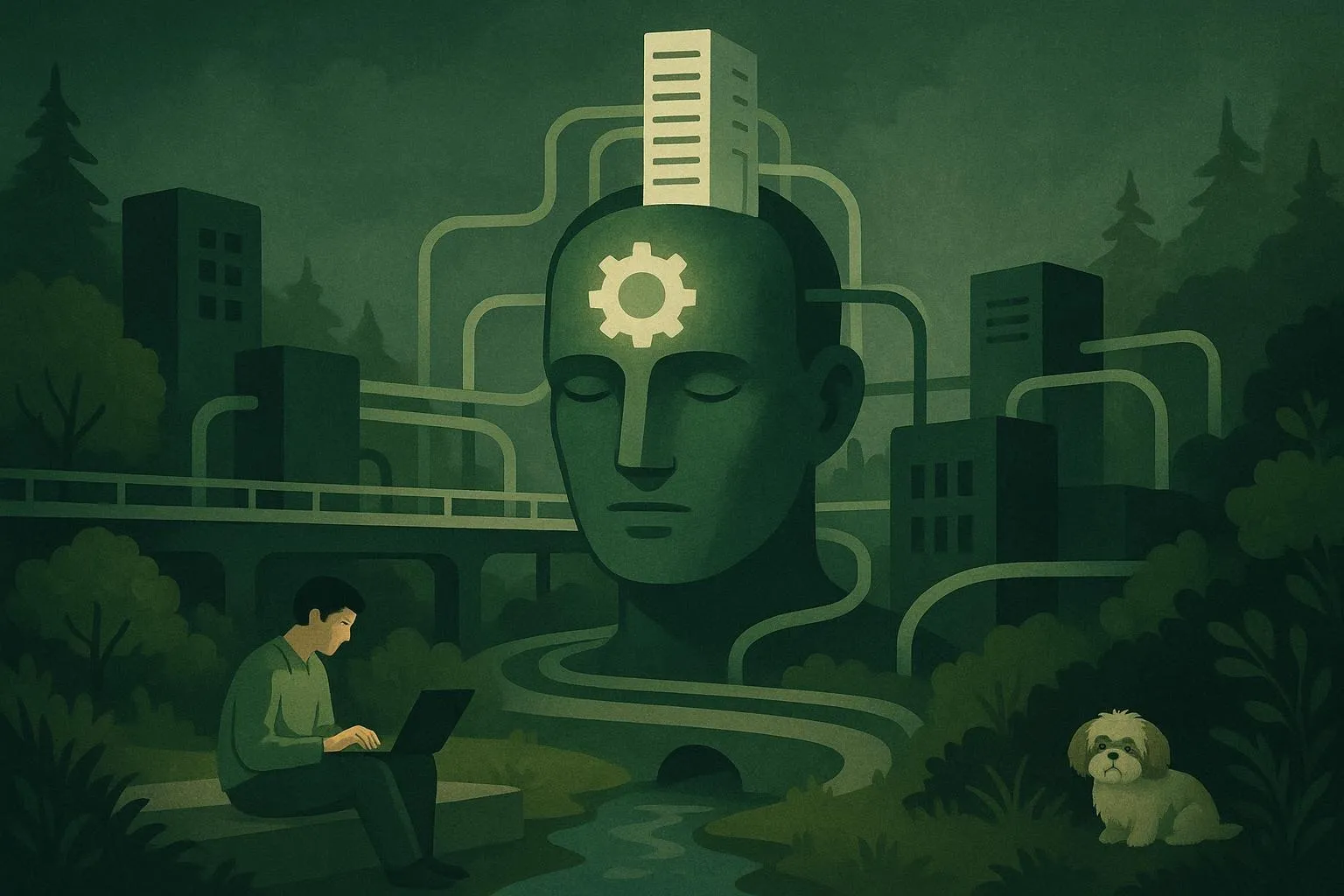
It’s not really serving the people. It’s just serving a select few privatized organizations. And on top of that, no one is even talking about the fact that this was supposed to be unlocking things like universal basic income and a stronger social structure for every individual. We’re losing the land, and the society built on it. It’s a three-way attack: corporate extraction, unchecked AI infrastructure, and a government that has stopped protecting us.
Corporate Extraction: The Louisiana Preview
Before we talk about what’s coming for the rest of the country, we need to look at what’s already happened. Louisiana is a preview of what corporate extraction looks like when the government steps aside and lets industry write the rules.
Here’s Louisiana, ranked by the numbers. Dead last — #50 overall in U.S. News & World Report’s Best States rankings. #50 in economy. #50 in crime and corrections. #46 in education. #44 in health care. #49 in natural environment. Median household income? $58,229. The national average is $76,976. Poverty rate? 18.9% versus 12.2% nationally. This is not an accident. This is the result of policy.
But the most visible scar on Louisiana is something called Cancer Alley.
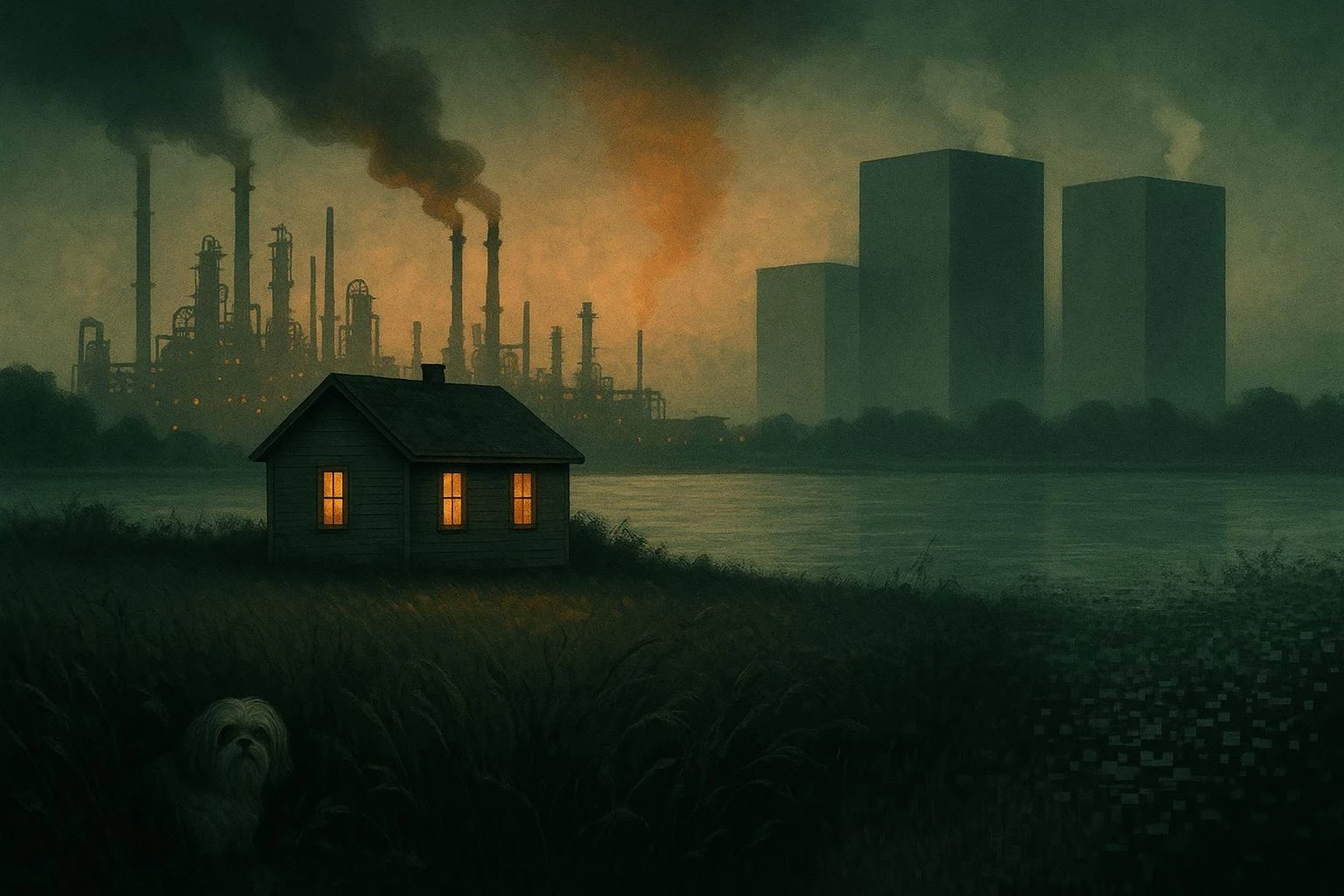
Cancer Alley is an 85-mile stretch of land along the Mississippi River between Baton Rouge and New Orleans. It contains over 200 petrochemical plants and refineries — the largest concentration of fossil fuel and petrochemical operations in the entire Western Hemisphere. The cancer risk for residents living there is 47 times greater than the acceptable threshold set by the U.S. government1.
One plant alone — the Denka Performance Elastomer facility in St. John the Baptist Parish, formerly owned by DuPont — emits 99% of the nation’s chloroprene pollution2. The EPA found that residents near this plant face a cancer risk from air pollution over 700 times the national average2.
Human Rights Watch released a report in January 2024 titled “We’re Dying Here: The Fight for Life in a Louisiana Fossil Fuel Sacrifice Zone.” The UN Human Rights Committee formally condemned Cancer Alley as environmental racism in March 2021, stating that it “poses serious and disproportionate threats to the enjoyment of several human rights of its largely African American residents”3.
In 2023, the EPA itself found significant evidence that Louisiana regulators’ actions and inactions “have resulted and continue to result in a range of adverse impacts on African American residents”4.
And then in March of 2025 — just last year — the Trump administration dropped the federal case against Denka, citing its policy of ending Diversity, Equity, and Inclusion initiatives5. The DOJ walked away from a community that has been breathing poison for decades, and they openly linked the decision to dismantling DEI.
But here’s the thing: they promised these communities jobs. They said the plants would bring prosperity. And yet in St. Gabriel, where there are 30 large petrochemical plants within a ten-mile radius, only 9% of full-time industry jobs are held by local residents, and at least one in four residents lives in poverty6. The economic prosperity never arrived. It was never going to.
The $20 Billion Giveaway
Here’s something that made my jaw drop when I learned it.
For nearly 80 years, Louisiana has been running a program called the Industrial Tax Exemption Program, or ITEP. The idea was simple: give massive property tax breaks to industrial corporations in exchange for jobs and economic growth. Supposedly. Since the program began in 1936, Louisiana has given away an estimated $20 billion in property tax revenue to industrial corporations — money that could have funded schools, roads, hospitals, and community services7.
$20 billion. That’s the cost of treating a state like a colonial extraction operation. Give the corporations everything they want, starve the communities, and then wonder why the state ranks dead last in everything.
And this is exactly what the corporate class is now doing to the rest of the United States. Louisiana just got there first.
Unchecked AI: The New Extraction
Now here comes the next wave. AI data centers.
Global data centers consumed about 415 terawatt-hours of electricity in 2024 — roughly 1.5% of all global electricity. The International Energy Agency projects that number could double to 945 TWh by 2030, with AI identified as the main driver of growth8.
A mid-sized data center uses about 1.4 million liters of water per day for cooling9. Researchers estimate that global AI water withdrawal could reach 4.2 to 6.6 billion cubic meters by 202710. By 2030, AI servers in the United States alone could require between 731 and 1,125 million cubic meters of water annually, with 24 to 44 million metric tons of associated carbon emissions11.
Google’s greenhouse gas emissions increased nearly 50% from 2019 to 2024, driven in large part by the energy demands of AI data centers12. Generative AI could add 1.2 to 5 million tonnes of electronic waste by 203013.
And let’s be clear about what these data centers actually produce. They don’t produce jobs. A data center might employ a few dozen people to maintain servers that serve millions. They don’t integrate into communities. They’re windowless concrete monoliths that consume local water, strain local power grids, increase electricity costs for residents, and return almost nothing to the people who live next to them.
People are noticing. A Gallup poll from March 2026 found that 70% of Americans oppose the construction of new AI data centers in their neighborhood14. Local opposition movements delayed or cancelled $156 billion worth of data center projects in 2025 alone15. Bills limiting or proposing moratoriums on new data centers have been introduced in Georgia, Maryland, Michigan, Minnesota, New York, Oklahoma, South Carolina, South Dakota, Vermont, and Virginia16. This resistance is working. But it needs to scale.
The Bubble That Burns the Planet
Meanwhile, the AI industry is running what increasingly looks like the largest speculative bubble in history.
OpenAI has committed to spending $1.4 trillion over 8 years on data center infrastructure. Their current annual revenue? About $13 billion17. The company is burning $15 million per day on Sora alone and expects to report $74 billion in operating losses in 202818.
Nvidia’s market cap hit $5 trillion — higher than the GDP of every country on Earth except the United States and China19. AI-related enterprises accounted for roughly 80% of all stock market gains in the United States in 202520. That’s not a healthy economy. That’s a single bet on a single technology, fueled by a circular flow of money where Nvidia invests in OpenAI so OpenAI can buy Nvidia’s GPUs21.
The Bank of England and the International Monetary Fund have both issued formal warnings about a potential market correction if the AI bubble bursts22. JP Morgan CEO Jamie Dimon, the head of the largest bank in America, said the “level of uncertainty should be higher in most people’s minds”23.
And despite all this spending — all these trillions — a National Bureau of Economic Research study from February 2026 found that 90% of firms reported no impact of AI on workplace productivity24.
Let that sink in. Trillions of dollars. Gigawatts of power. Billions of liters of water. And nine out of ten businesses say it hasn’t changed a thing.
The Government Stepped Aside
I’m not saying we destroy AI. I’m saying we slow down. We legislate. We force efficiency and environmental accountability as the ultimate goal — not “spend more” as some kind of achievement. We stop letting capitalists turn every advancement into a zero-sum hustle that extracts wealth from communities and puts the cost on the American people.
The government is not doing anything to protect us. Its policy-making is absent. So it’s on us. Protect your local communities. Protect the land. There are equitable solutions. We need to take back the government, open up negotiations, and protect our world.
Contemporary Americans have a very brief history compared to the natives, but we’re all a part of the story of this land. How we got here is less important than what we’re going to do to preserve it and care for it now. We need to make a stand against data centers.
The land is what should bond us. It’s the one thing we all share.
I’m not really interested in living in a Mad Max-style doggy-eat-dog world.
I just wanna hang out with my dog. 🐕 🌎 ✌️ ❤️
Footnotes
-
Buerk, Ellen. “Sacrifice Zone: Conciliating Racial Discrimination in Louisiana’s ‘Cancer Alley.’” Case Western Reserve Journal of International Law, vol. 57, no. 1, 2025, p. 491. Also: U.S. Environmental Protection Agency, National Air Toxic Assessment. ↩
-
U.S. Environmental Protection Agency. Civil rights investigation and Clean Air Act complaint against Denka Performance Elastomer, 2023. The EPA found the facility emits 99% of the nation’s chloroprene, and air monitoring near the plant showed chloroprene levels as high as 14 times the recommended safe level. ↩ ↩2
-
United Nations Human Rights Committee. Discussion on environmental racism and industrial projects along the Mississippi River in Louisiana, March 2, 2021. ↩
-
U.S. Environmental Protection Agency. Civil rights investigation of Louisiana state agencies regarding permitting in Cancer Alley, findings published 2023. ↩
-
U.S. Department of Justice. Dismissal of federal case against Denka Performance Elastomer, March 7, 2025. The DOJ linked the withdrawal to the administration’s policy of ending federal Diversity, Equity, and Inclusion (DEI) initiatives. ↩
-
Maraniss, David; Weisskopf, Michael. “The Faces of Pollution.” Los Angeles Times, January 24, 1988. Updated data confirmed in Human Rights Watch, “We’re Dying Here,” January 2024. ↩
-
Louisiana’s Industrial Tax Exemption Program (ITEP), established 1936. Estimates of total foregone property tax revenue over the program’s history come from reporting by Together Louisiana and the Louisiana Budget Project. For context on how ITEP functions, see the broader discussion in the Cancer Alley research and Human Rights Watch’s 2024 report documenting the relationship between industrial tax exemptions and community underinvestment in Louisiana. ↩
-
International Energy Agency. Energy and AI, Executive Summary, 2025. Global data center electricity consumption estimates and projections. ↩
-
LaBrecque, Sarah. “Desert storm: Can data centres slake their insatiable thirst for water?” Reuters, December 17, 2025. ↩
-
Li, Pengfei; Yang, Jianyi; Islam, Mohammad A.; Ren, Shaolei. “Making AI Less ‘Thirsty.’” Communications of the ACM, 2025. ↩
-
Nature Sustainability, 2025 study on projected water and carbon impact of AI servers in the United States through 2030. ↩
-
Gomes, Ben; Brandt, Kate. “Our 2024 Environmental Report.” The Keyword, Google, July 2, 2024. Google reported a 13% year-over-year increase in 2023, and cumulative data shows nearly 50% increase from 2019-2024. ↩
-
Wang, Peng; Zhang, Ling-Yu; Tzachor, Asaf; Chen, Wei-Qiang. “E-waste challenges of generative artificial intelligence.” Nature Computational Science, vol. 4, no. 11, 2024, pp. 818-823. ↩
-
Gallup. “Americans Oppose Data Centers in Their Area.” March 2026. ↩
-
Data Center Watch. Report on delayed and cancelled data center projects, March 27, 2026. ↩
-
National Conference of State Legislatures. “Which States Are Banning Data Centers?” 2026. ↩
-
Bort, Julie. “Sam Altman says OpenAI has $20B ARR and about $1.4 trillion in data center commitments.” TechCrunch, November 6, 2025. ↩
-
Smith, Dave. “OpenAI says it plans to report stunning annual losses through 2028.” Fortune, November 12, 2025. Tangermann, Victor. “Asset Manager Warns That OpenAI Is Likely Headed for Financial Disaster.” Futurism, January 25, 2026. ↩
-
Nishant, Niket; Singh, Rashika. “Nvidia hits $5 trillion valuation as AI boom powers meteoric rise.” Reuters, October 29, 2025. ↩
-
Jamali, Lily. “‘It’s going to be really bad’: Fears over AI bubble bursting grow in Silicon Valley.” BBC News, October 11, 2025. ↩
-
Gu, Jacqueline; Metz, Cade. “How OpenAI Uses Complex and Circular Deals to Fuel Its Multibillion-Dollar Rise.” The New York Times, October 31, 2025. ↩
-
Makortoff, Kalyeena. “Bank of England warns of growing risk that AI bubble could burst.” The Guardian, October 8, 2025. ↩
-
Jack, Simon; McNamee, Michael Sheils. “America’s top banker sounds warning on US stock market fall.” BBC News, October 9, 2025. ↩
-
Yotzov, Ivan; Barrero, Jose Maria; Bloom, Nicholas; et al. “Firm Data on AI.” National Bureau of Economic Research, Working Paper 34836, February 2026. ↩